ACLU of Texas Statement on Gov. Abbott Signing Abortion Ban into Law
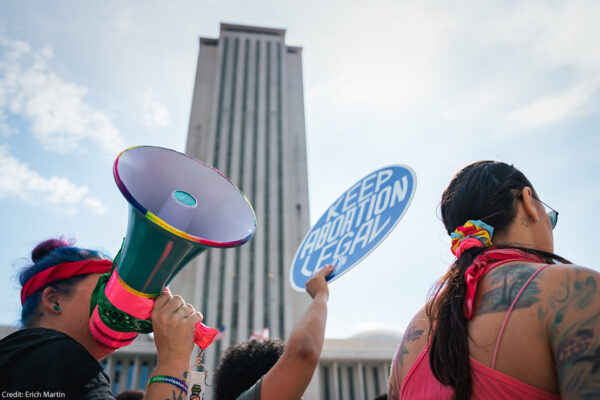
AUSTIN, Texas — Gov. Greg Abbott today signed Senate Bill 8 into law, banning abortion in Texas as early as six weeks gestation and allowing anyone — even a stranger — to sue any person who supports someone seeking abortion care.
The following statement can be attributed to Drucilla Tigner, policy and advocacy strategist of the ACLU of Texas.
“Governor Abbott just signed into law the most extreme abortion ban in the country, effectively outlawing abortions before most people would know they are pregnant. Not only does this ban violate more than half a century of Supreme Court caselaw, it paves the way for anti-choice extremists to use our court system to go after anyone who performs abortions or considers supporting a person that has one. But make no mistake, abortion is both legal in Texas and supported by the majority of Texans. The governor’s swipe of a pen can’t change the Constitution.”
The ACLU of Texas and Planned Parenthood sued the City of Lubbock on May 17 to block a similar ban on abortion within its city limits. The complaint can be found .
Related Issues
Related Content
-
News & CommentaryOct 2026
Reproductive Freedom
Healthcare Professionals, Advocates, And Impacted People Share Why They Support Reproductive Freedom On The Ballot In Virginia. Explore News & Commentary.Healthcare Professionals, Advocates, and Impacted People Share Why They Support Reproductive Freedom on the Ballot in Virginia
Voters in Virginia have the chance to vote for a ballot amendment that would enshrine abortion rights in the state’s constitution and further protect reproductive freedom in the South. -
Press ReleaseSep 2026

Reproductive Freedom
Aclu Statement On The 50th Anniversary Of The Hyde Amendment, Which Bans Abortion Coverage In Federal Programs. Explore Press Release.ACLU Statement on the 50th Anniversary of the Hyde Amendment, which Bans Abortion Coverage in Federal Programs
WASHINGTON — This year marks the 50th anniversary of the Hyde Amendment, a harmful annual budget rider that bans abortion coverage in the Medicaid program and has since been expanded to apply to virtually all federal health plans and programs. Since it was first enacted on September 30,1976, this discriminatory policy has, by design, pushed abortion care out of reach for low-income people who struggle to make ends meet, especially Black, Latine, and Indigenous people. Under Hyde — and compounded by the reproductive care crisis that followed the overturning of Roe v. Wade in 2022 — patients seeking an abortion are forced to cobble together the funds to pay out of pocket, with this time-sensitive care often being delayed as a result. For too many patients, the financial barrier created by Hyde forces them to continue a pregnancy against their will. Voters across the country agree that all forms of pregnancy-related care, including abortion, should be covered by health plans, regardless of one’s income or source of insurance. Recent polling shows that more than two-thirds of registered voters support Medicaid coverage of abortion — demonstrating a strong desire to lift the Hyde Amendment. In response, Jessica Arons, Director of the Liberty Division for Policy & Government Affairs at the American Civil Liberties Union (ACLU), issued the following statement: “Every person should have the freedom to make the decisions about pregnancy that are best for them — including whether to have an abortion — without political interference. The Hyde Amendment takes that important, personal decision away from millions of people, especially women with low incomes and women of color. “A half century of this despicable policy is enough. Hyde was the first step in eroding the federal right to abortion, and rectifying it needs to be the first step in restoring that right. We call on Congress to not only protect the right to abortion but also ensure meaningful access to care by passing the Equal Access to Abortion Coverage in Health Insurance (EACH) Act, which would end this cruel and insidious policy by eliminating the Hyde Amendment and all abortion coverage bans.” The Hyde Amendment denies abortion coverage to 7.7 million women of reproductive age insured through Medicaid, half of whom are women of color. Other related bans deny coverage to Indigenous people, people who are serving in the military, veterans, federal employees, District of Columbia residents, and those who are imprisoned or detained by the federal government (including by Immigration and Customs Enforcement). -
Press ReleaseSep 2026
Reproductive Freedom
Federal Court Dismisses Nfprha And Fhccp Lawsuit Challenging Trump Administration’s Attempt To Undermine Title X Family Planning Program . Explore Press Release.Federal Court Dismisses NFPRHA and FHCCP Lawsuit Challenging Trump Administration’s Attempt to Undermine Title X Family Planning Program
HARRISBURG, Pa. — A federal district court yesterday dismissed National Family Planning and Reproductive Health Association et al. v. Kennedy et al., a lawsuit brought by National Family Planning & Reproductive Health Association (NFPRHA) and its member, the Family Health Council of Central Pennsylvania (FHCCP), aimed at protecting the integrity of the Title X program — the country’s only dedicated program for family planning services. By dismissing the family planning providers’ lawsuit, the court opens the door for the Trump administration to severely undermine access to effective birth control methods, cancer screenings, STI testing and treatment, and other preventive care for millions of people, mostly with low incomes, across the country. “Congress created Title X to help people get access to contraception and sexual health care they otherwise could not afford,” said Clare Coleman, president & CEO, NFPRHA. “At a time when people across the country are struggling with high costs, this administration is trying to force health care providers to adhere to its political priorities to secure federal funding. Agreeing with this administration does not make health care easier to access or improve its quality. While this federal court ruling is a significant setback, NFPRHA and its members will continue to prioritize nationally recognized clinical standards, evidence-based best practices, and patient experience in delivering Title X-funded care, over demands for ideological alignment.” In April, the Department of Health and Human Services (HHS) issued a Title X Notice of Funding Opportunity (NOFO) for fiscal year (FY) 2027 designed to corrupt a merit-based grant competition by prioritizing ideology over quality and qualifications. The NOFO was written to enable the federal government to push highly qualified Title X providers out of the program and bring in new grantees based solely on their alignment with the Trump administration’s political priorities, some of which have nothing to do with the Title X program, the services Congress intended for it to provide, or the patients it is intended to serve. NFPRHA and FHCCP, represented by the American Civil Liberties Union (ACLU) and the ACLU of Pennsylvania (ACLU-PA), sued the Trump administration in June, challenging aspects of the NOFO under the Administrative Procedure Act. The plaintiffs argued that certain NOFO requirements violated the Title X regulations and were arbitrary and capricious, as they failed to provide applicants fair notice of what the agency was asking of them, and failed to acknowledge or explain the agency’s sudden shift in position on the import of contraception and diversity, equity and inclusion, including for transgender people, in the Title X program. Following the filing of the lawsuit, the administration revised the NOFO to remove one challenged component: a provision enabling the administration to reject applicants at a threshold stage for failure to sufficiently align with the Trump administration’s political priorities. But the administration left other unlawful aspects in place, including requirements that are in direct conflict with Title X regulations requiring care to be provided in an inclusive, equitable, and non-discriminatory manner. Notwithstanding the competitive disadvantage and confusion attributable to the challenged requirements, the court dismissed the case on procedural grounds, based on its view that NFPRHA’s members, including FHCCP, do not face any present harm. “A court ruling does not change what is at stake for the people and communities who rely on Title X for essential health care. FHCCP has administered Title X in Central Pennsylvania since the program’s inception more than 50 years ago, and we fully intend to continue that work,” said Patricia Fonzi, president and CEO of FHCCP. “Our concern has never been whether FHCCP receives another grant — it is whether Title X funding decisions are based on providers’ demonstrated ability to deliver high-quality care and meet the needs of their communities. When experienced providers can be pushed aside for arbitrary reasons, it is clients and communities who ultimately pay the price.” “We are deeply disappointed that the court refused to review this case on the merits and protect the Title X program from the Trump administration’s attempt to undermine it,” said Meagan Burrows, senior staff attorney for the ACLU Reproductive Freedom Project. “Today’s decision is legally wrong and risks harming the millions of patients across the country who depend on the Title X program for access to vital family planning services. We will continue doing everything in our power to protect people’s ability to get the care they need to exercise their reproductive freedom, including from Title X providers.” This lawsuit, National Family Planning and Reproductive Health Association et al. v. Kennedy et al., was filed in the Middle District of Pennsylvania. More information about the case is available here. -
Press ReleaseSep 2026
Reproductive Freedom
Federal Appeals Court Hears Baseless Challenge To The Abortion Pill Mifepristone — Again. Explore Press Release.Federal Appeals Court Hears Baseless Challenge to the Abortion Pill Mifepristone — Again
NEW ORLEANS — A federal appeals court today will again hear a lawsuit designed to restrict abortion access nationwide by banning mail and pharmacy dispensing of mifepristone, a safe and effective medication used in two-thirds of U.S. abortions as well as for miscarriage care. The hearing before the U.S. Court of Appeals for the Fifth Circuit in Louisiana v. U.S. Food and Drug Administration is the latest step in a legal battle in which anti-abortion politicians are seeking to make abortion harder for patients to access, even in states where abortion is protected. Today, nearly 30 percent of people who have abortions in the U.S. access care through telemedicine and pharmacy dispensing. “Abortion opponents will stop at nothing to try to end medication abortion in every state,” said Julia Kaye, senior staff attorney with the ACLU’s Reproductive Freedom Project. “Preventing people from getting their mifepristone prescription by mail and at pharmacies is just the start. But we’re not standing by as the courts and the Trump administration weigh whether to reduce access based on tired anti-abortion lies. The ACLU will use every tool we have to protect access to this safe and effective medication for people across the country.” In May, the Fifth Circuit ruled for Louisiana, resulting in a brief disruption of telehealth access to mifepristone before the U.S. Supreme Court temporarily paused the appeals court’s decision while the litigation continues. The case is widely expected to return to the Supreme Court. Any decision from the Fifth Circuit to limit telehealth access will be on hold until then. Legal challenges are not the only threat to patients’ ability to access mifepristone. Despite use by millions of patients, hundreds of studies, and decades of evidence proving mifepristone’s safety, including when prescribed through telemedicine, the Trump administration, after intense lobbying from abortion opponents and their allies in Congress, is conducting yet another review of mifepristone as a pretext for imposing extreme and medically unjustified restrictions on access to the medication. The administration announced the review citing one self-published report that grossly distorts mifepristone’s safety record. This report has since been widely debunked, including by more than 250 experts. Regardless of whether restrictions on mifepristone come from the courts or from the Trump administration, ending telehealth and pharmacy access will devastate patients’ ability to get this essential medication. Without telemedicine and pharmacy access, patients using mifepristone would be forced to travel, sometimes hundreds of miles, to a health center just to pick up a pill, a requirement that leading medical authorities agree has no safety benefit. Both the public and experts agree: the federal government should not further restrict mifepristone. A July 2026 survey found that two-thirds of U.S. adults oppose nationwide restrictions on mifepristone and medication abortion. And a wide range of experts — from emergency medicine physicians to experts in intimate partner violence to drug developers — submitted amicus briefs in the Supreme Court and in the court of appeals opposing this nationwide restriction as medically unjustified and harmful to people seeking care.