2023 in Review: The Latest on the Stories That Made Our Year
December 14, 2023
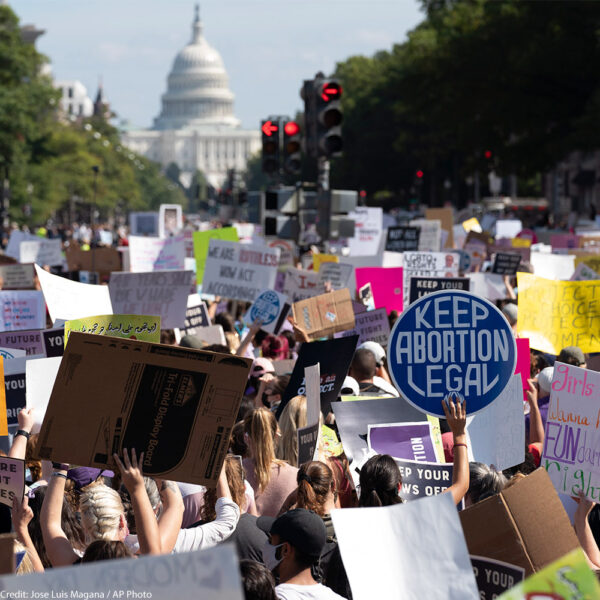
2023 is coming to a close, and we have weathered so much this year. At the ACLU, we continue to fight for civil rights and civil liberties across the country. We’re prying open every opportunity for abortion access and reproductive health care following the overturn of Roe, blocking trans health care bans nationwide, filing lawsuits to curb the rise in book bans and educational censorship, and advocating for racial equity after the elimination of affirmative action and continued attacks on voting rights. So today, we're highlighting some of the most notable episodes from the year, which also happen to be some of our favorites. We’ll chat about what we enjoyed, how they came to be, and where the issues we reported on stand today. We hope you enjoy it.
Kendall Ciesemier

Vanessa Handy
Listen to this episode on
This Episode Covers the Following Issues
Related Content
-
Press ReleaseSep 2026

National Security
Free Speech
Court Denies Trump Administration’s Bid To Dismiss Case Challenging Icc Sanctions On First Amendment Grounds. Explore Press Release.Court Denies Trump Administration’s Bid to Dismiss Case Challenging ICC Sanctions on First Amendment Grounds
BANGOR, Maine — On Monday, the U.S. District Court for the District of Maine allowed the central claims in Smith v. Trump to move forward, rejecting the Trump administration’s effort to dismiss two U.S. human rights advocates’ challenge to President Trump’s sanctions targeting the International Criminal Court (ICC). In July 2025, the court issued a preliminary injunction prohibiting the administration from punishing human rights advocates Matthew Smith and Akila Radhakrishnan for their communications with the ICC. The Trump administration then asked the court to dismiss the lawsuit. On Monday, the court refused. The court’s order allows the human rights experts’ claims to proceed. “In my work, I help the ICC investigate hideous crimes committed against the people of Myanmar, including mass murder, torture, and human trafficking,” said Matthew Smith, founder and CEO of Fortify Rights. “This Executive Order undermines international justice efforts and obstructs the path to accountability for communities facing unthinkable horrors.” Under Executive Order 14203, people in the U.S. who’ve devoted their lives to seeking justice for the victims of atrocities — like the genocide of Myanmar’s Rohingya people, or gender-based violence committed against Afghan women under the Taliban — could face stiff penalties simply for exercising their constitutional right to engage and advocate with ICC investigators and prosecutors. As the lawsuit explains, these sanctions violate the First Amendment by prohibiting the advocates, and other Americans like them, from communicating with the ICC’s Office of the Prosecutor, including by providing legal advice, expert analysis, and evidence. “Victims of the Taliban’s oppression can’t rely on their own courts for justice. That’s why they turn to the ICC, and why it's so important for me to be able to partner with them in their fight for justice and accountability,” said Akila Radhakrishnan, an international human rights lawyer. “I’m bringing this suit to prevent my own government from punishing me for trying to hold the Taliban accountable for its systematic violence against women and girls from Afghanistan.” Monday’s order is not a final ruling on whether the restrictions imposed by the sanctions violate the law. Nevertheless, the court wrote that it had enough to conclude, on the record before it, that “there is a strong likelihood the EO violated Plaintiffs’ First Amendment rights.” The court also wrote that, under the human rights experts’ “reasonable interpretation,” the executive order was “incompatible” with the federal statute the administration invoked as authority for the sanctions. The court also rejected the administration’s arguments that the human rights experts lacked standing and that their claims were not ready for review. “The government’s attempt to dismiss our clients’ claims was both predictable and meritless,” said Charlie Hogle, staff attorney with ACLU’s National Security Project. “The First Amendment doesn’t allow the government to impose sweeping limits on what Americans can say and who they can say it to. We’re pleased our clients can continue their important work, and we look forward to continuing to vindicate their rights in court.” The international community, including the United States, established the ICC in 1998 to help maintain international peace and security. The ICC investigates and prosecutes crimes of the severest magnitude — including genocide, crimes against humanity, and war crimes — when domestic courts are unwilling or unable to do so. Today, 125 countries have joined the ICC’s founding treaty, known as the Rome Statute. As the lawsuit explains, although the United States has not ratified the Rome Statute, it has supported the ICC’s critical work on a wide range of matters. “Our clients’ human rights work is protected by the First Amendment, and the court’s ruling affirms that the executive order is an unlawful ban on that important work,” said Anahita Sotoohi, staff attorney at the ACLU of Maine. “We are pleased that our clients can continue their activism while the case is pending.” This lawsuit was filed in the United States District Court for the District of Maine by the ACLU and ACLU of Maine. -
Press ReleaseSep 2026
National Security
Free Speech
Cair And Cair-florida Denied Opportunity To Be Heard Before Florida Cabinet Vote To Approve Unconstitutional Terrorism Designation. Explore Press Release.CAIR and CAIR-Florida Denied Opportunity to be Heard Before Florida Cabinet Vote to Approve Unconstitutional Terrorism Designation
TALLAHASSEE — At Tuesday’s Florida Cabinet meeting, Gov. Ron DeSantis and other state officials followed through on their campaign to designate two leading Muslim civil rights nonprofits as “domestic terrorist organizations.” The groups, the Council on American-Islamic Relations (CAIR) and its state chapter, CAIR-Florida, filed a lawsuit challenging the baseless designation in federal court in early July. At a Cabinet meeting in which Gov. DeSantis and four Cabinet members voted on the designation, counsel with the ACLU stood up and asked Gov. DeSantis for an opportunity to speak on behalf of CAIR and CAIR Florida. According to a new emergency rule to implement the Florida law, the Governor and Cabinet have sole discretion to decide whether an organization to be designated can present arguments against designation. Notice and an opportunity to be heard are fundamental due process requirements. Gov. DeSantis did not acknowledge and spoke over the ACLU’s request, said he heard no objections from the Cabinet, and approved the designation. The entire vote consideration took thirty seconds. On behalf of CAIR and CAIR-Florida, the ACLU, ACLU of Florida, the Southern Poverty Law Center, and Bondurant Mixson & Elmore LLP plan to file an amended complaint and an emergency motion to stop the designations from becoming effective. If the designation does go into effect, the groups will be forced to shut down their operations in the state under threat of severe criminal penalties against them as well as their employees, board members, volunteers, and other stakeholders in Florida. “As I wanted to explain before the Cabinet voted to designate our clients, Gov. DeSantis’s use of Florida’s dangerous new “terrorism” designation regime against CAIR and its Florida chapter is baseless and unconstitutional,” said Hina Shamsi, director of ACLU’s National Security Project. “There are simply no legitimate grounds to brand our clients with a reviled label, impose crippling criminal penalties, and force them to shut their doors in Florida. As the country's leading Muslim civil rights group, CAIR is being targeted not because it poses a threat to public safety, but because doing so serves a political agenda at the expense of Floridians' rights. CAIR and all U.S. nonprofits have the right to criticize the government, protect religious freedom, and advocate for the causes they believe in. We look forward to vindicating our clients’ rights in court.” If the courts do not intervene, the designation will become effective on November 5. -
NevadaSep 2026

Privacy & Technology
National Security
Killinger V. Jager. Explore Case.Killinger v. Jager
On September 21, 2026, the ACLU, ACLU of Nevada and the Innocence Project filed an amicus brief in the District of Nevada in support of Jason Killinger, a man wrongfully arrested after police relied on an incorrect result from facial recognition technology. -
Press ReleaseSep 2026
National Security
Human Rights
Aclu Statement Commemorating 25 Years Since September 11 Attacks. Explore Press Release.ACLU Statement Commemorating 25 Years Since September 11 Attacks
NEW YORK - In remembrance of the 25th anniversary of the September 11, 2001 attacks, Anthony D. Romero, executive director of the American Civil Liberties Union, issued the following statement: “Twenty-five years after the attacks on Sept. 11, 2001, the ACLU remembers the victims, their families, and all of those impacted. We pay particular tribute to John William Perry, a New York Police Department officer, lawyer, and longtime member of the Nassau County Chapter board of the New York Civil Liberties Union who tragically died in the rescue effort. "The lessons of the post-9/11 era apply to the abuses of power we face today. Immediately following the attacks, the ACLU urged government leaders to respond justly and in accordance with the safeguards enshrined in our Constitution. “Instead, successive presidents claimed expansive power that eroded many of our fundamental freedoms. U.S. leaders authorized torture and indefinite detention, launched illegal wars, warrantlessly surveilled Americans, and signed off on other horrific human rights violations. The Patriot Act was rubber-stamped by a Congress too afraid to ask the tough questions. And the courts all too often abdicated their role in our system of checks and balances and deferred to the executive. “Yet, thanks to the tireless work of civil liberties and civil rights organizations, human rights groups, investigative journalists, and the communities who were at the center of the harm, some of the worst abuses of that era came to light — and some of them ended. Other abuses continue to this day: Notably, key provisions within the Patriot Act are still the law of the land, and the government is still prosecuting individuals through a military commission process that has never worked and will never render true justice. "As we challenge the Trump administration's daily assault on our civil liberties and civil rights, we remain steadfast in the knowledge that our nation’s true strength lies in its people, an independent judiciary, and our commitment to due process. “The tragedy of 9/11 taught us that adherence to the rule of law is what makes this country great. Twenty-five years ago, we learned that we ought not forfeit our civil liberties in the face of government officials who are abusing their power. That lesson is doubly relevant today.”