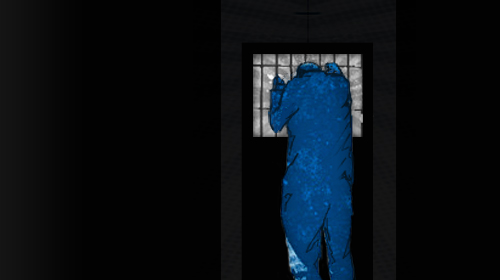
The first-ever (and long-overdue) congressional hearing on solitary confinement convenes tomorrow, June 19, at 10 a.m. before the Senate Judiciary Subcommittee on the Constitution, Civil Rights and Human Rights. You’ll be able to watch a webcast of the hearing on the , and follow our using #stopsolitary.
Among others, the committee will hear from Mississippi Department of Corrections Commissioner , who is rethinking the use of solitary in Mississippi correctional facilities; , who spent years in solitary on Texas’ death row before being exonerated; , a professor of psychology at the University of California, Santa Cruz who has studied and written about psychological trauma among prisoners held in long-term solitary confinement; and of the Justice Fellowship/Prison Fellowship Ministries, a leader in the conservative movement for criminal justice reform.
The ACLU, which fights the dangerous overuse of solitary confinement through its Stop Solitary campaign, will submit written testimony. Check back tomorrow for a recap of the hearing.
Learn more about solitary confinement: Sign up for breaking news alerts, , and .
Related Issues
Related Content
-
Press ReleaseOct 2026

Criminal Law Reform
Prisoners' Rights
Supreme Court Rejects Arizona’s Attempt To Halt Court-ordered Oversight Of Prison Health Care. Explore Press Release.Supreme Court Rejects Arizona’s Attempt to Halt Court-Ordered Oversight of Prison Health Care
WASHINGTON – The Supreme Court today rejected Arizona’s request to stop a court-appointed receiver from assuming control and management of health care provided to more than 25,000 people incarcerated in Arizona Department of Corrections, Rehabilitation, and Reentry (ADCRR) prisons. The decision allows the receivership ordered by a federal judge to move forward after a decade of litigation over unconstitutional and deadly conditions in Arizona prisons. The lawsuit, Jensen v. Thornell, was filed in 2012 by the Prison Law Office, the American Civil Liberties Union (ACLU), ACLU of Arizona, and Disability Rights Arizona. For more than a decade, ADCRR has been on notice about the systemic health care failures in its prisons and has yet to address the issue, despite multiple court orders and interventions. In July 2026, after years of reporting from independent experts detailing the deadly consequences of the state’s failure to comply, Judge Silver ordered a receiver to oversee prison health care. “Arizona has spent years fighting accountability at every turn while people in its prisons continue to suffer and die from preventable causes,” said Corene Kendrick, deputy director of the ACLU’s National Prison Project. “During that time, the state has paid millions of dollars in fines and spent enormous sums litigating this case, and people in ADCRR custody pay the highest price of all. The question is not whether there is a crisis – that has been documented time and time again. The question is whether Arizona will stop fighting and start fixing it. Today’s decision clears the way for a receiver to do what the state has failed to do for more than a decade. Court-appointed independent monitors have repeatedly documented preventable deaths, permanent injuries, and needless suffering because of the state’s failure to comply with court orders. In one case, a man died after ADCRR discontinued his necessary anti-seizure medication without reviewing his medical history. In another, a man who suffered a heart attack and underwent heart surgery died after the state failed to provide him follow up care or properly manage his medication. Monitors also documented five suicides in the first three months of 2024 that they concluded may have been prevented had the state followed the court’s orders. Additional quotes are as follows: “This outcome will allow the critical and long-awaited work of the receiver to move forward, and for class members to obtain the relief the district court ordered years ago,” said Maya Abela, deputy legal director at Disability Rights Arizona. “Further delay would have only served to increase the risk of harm to incarcerated people in Arizona’s state-operated prisons, and we are glad the Court recognized that this must not be allowed to occur.” “The decision from the Supreme Court confirms what we’ve known — a court-ordered receiver must be allowed to step in and address the serious deficiencies within the state prison system and ensure ADCRR is being held accountable to their constitutional duties,” said Tara DeGeorge, legal director at the ACLU of Arizona. “For far too long, people in ADCRR custody have been unjustly subject to inadequate medical and mental health care resulting in unnecessary medical complications and even death. ADCRR has had more than enough time to address the dire crisis — the only option left for successful reform is through a receivership.” “Despite more than a decade of litigation, Arizona’s prisons continue to be plagued by widespread and shocking medical and mental health neglect. We are relieved that the Supreme Court’s decision today will allow the receiver to begin the necessary, life-saving work of reforming the prisons’ healthcare system,” said Sophie Hart, managing attorney at the Prison Law Office. -
Oregon Supreme CourtAug 2026

LGBTQ Rights
Prisoners' Rights
Zyst V. Miller. Explore Case.Zyst v. Miller
Following the Oregon Department of Corrections’ unconstitutional treatment of a transgender prisoner, a habeas court ordered her removal from segregated housing, an individualized gender-affirming care assessment, a psychiatric evaluation, and identification of an appropriate cellmate. However, the Oregon Court of Appeals reversed the psychiatric-evaluation and cellmate orders, finding them “too attenuated” to qualify as habeas relief. The ACLU’s State Supreme Court Initiative, alongside the ACLU of Oregon, joined an amicus brief by the law firm Sugerman Dahab arguing that habeas courts have broad discretion to remedy violations and resulting harms. The brief explains that the Court of Appeals’ “close connection” test unduly constricts habeas relief, and which should be construed to encompass not only the need to halt ongoing constitutional violations, but also the need to mitigate various harms that may arise from those violations. -
ColoradoJul 2026
Prisoners' Rights
E.l. V. Claps. Explore Case.E.L. v. Claps
Family members of individuals incarcerated in Adams County Jail are challenging a ban on in-person visits on the grounds that it violates their right to familial association under the Colorado Constitution. The district court denied their motion for a preliminary injunction, in part based on its ruling that individuals cannot sue directly under the Colorado Constitution to stop violations of their individual rights if other remedies are theoretically available under state or federal law. If that ruling is left to stand, state constitutional protections could exist in name only, leaving courts unable to stop violations if a plaintiff could potentially proceed under a narrower statutory claim that might provide lesser relief or fail on the facts of the case. This case could therefore have far-reaching implications for the enforceability of constitutional rights across Colorado. -
Press ReleaseJun 2026
Prisoners' Rights
Aclu Statement Responding To The Supreme Court Ruling In Case On Religious Freedom For Incarcerated People. Explore Press Release.ACLU Statement Responding to the Supreme Court Ruling in Case on Religious Freedom for Incarcerated People
WASHINGTON — The Supreme Court issued a decision today ruling against Damon Landor, a Rastafari man whose dreadlocks were forcibly shaved by Louisiana prison officials in violation of his religious beliefs In a 6-3 decision, the court held that the Religious Land Use and Institutionalized Persons Act does not allow incarcerated people to seek monetary damages from individual prison officials, leaving people whose religious rights are violated in prison without a meaningful remedy in many cases. Statement from Daniel Mach, director of the ACLU’s Program on Freedom of Religion and Belief: “Today’s decision is a devastating blow to the religious freedom and dignity of incarcerated people. Prison officials held Damon Landor down and forcibly shaved his dreadlocks in violation of his Rastafarian faith, after throwing in the trash a copy of a binding federal court order confirming prisoners’ religious right to wear dreadlocks. By denying Mr. Landor a meaningful remedy, the Supreme Court has made it harder to hold prison officials accountable when they violate the rights of people in their custody. “Religious freedom does not stop at the prison gate, and civil rights are real only when they can be enforced. This decision sends a dangerous message that prison officials may escape accountability even for egregious violations of federal law. The ACLU will continue fighting to ensure that incarcerated people can practice their faith, protect their bodily autonomy, and seek justice when their rights are violated.” The ACLU’s amicus brief in this case is part of the Joan and Irwin Jacobs docket.