Trump’s Deportation Agenda Is Making the Affordability Crisis Worse
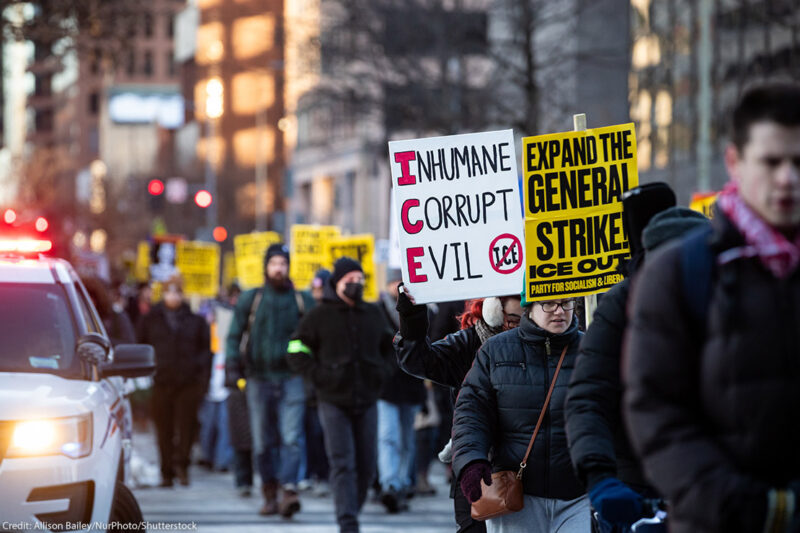
When U.S. Immigration and Customs Enforcement (ICE) agents descended upon Minnesota in the infamous “Operation Metro Surge,” they didn’t just arrest thousands of people and kill two people, traumatizing communities and needlessly spreading violence. They damaged the local economy — costing Minnesota businesses $10–$20 million a week in the aftermath, as people were terrified to to leave their homes to do ordinary things like go to work, school, doctors appointments.
The Trump administration’s deportation agenda is destabilizing communities across the nation, costing billions of taxpayer dollars, at a time when working families can’t afford groceries, childcare, rent, gas, and other essentials. According to , 95 percent of Americans believe there is an affordability crisis in the United States. But our economy isn’t just failing because of inflation and broken supply chains. The Trump administration’s mass deportation campaign is also largely to blame.
A new report from the ACLU and American Federation of Labor and Congress of Industrial Organizations (AFL-CIO), “Citizenship and the Affordability Agenda: A Path to Better Jobs, Higher Wages, and Prosperity for All,” highlights how mass deportations are killing jobs, raising prices, and damaging businesses.

Citizenship and the Affordability Agenda: A Path to Better Jobs, Higher Wages, and Prosperity for All
Citizenship and the Affordability Agenda: A Path to Better Jobs, Higher Wages, and Prosperity for All
The report also offers a practical solution: Urge policymakers to create a broader path to citizenship to stabilize jobs, raise wages, and trade this economy of fear for one that benefits working families across the nation.
Here, we break down key takeaways from the report to illustrate how President Donald Trump’s deportation agenda is impacting people’s livelihoods and how transformative immigration reform can improve the affordability crisis.
Mass Deportations Kill Jobs Held by U.S. Citizens
Administration officials claim that deporting immigrants will help create jobs and open up employment opportunities for U.S citizens. But the data tells a different story: Studies consistently link increased ICE activity to employment declines for all workers, immigrants and U.S.-born alike.
Roughly one in five workers in our country is an immigrant, and immigrants and U.S.-born workers are often linked through the same supply chains and industries. When enforcement actions remove workers from that chain, employers typically respond not by hiring citizens to fill the gap, but by cutting operations, delaying projects, and reducing hiring altogether — shrinking the labor supply and employers' revenue. Construction illustrates the scale: economists estimate the mass deportation agenda could eliminate nearly 20 percent of the construction workforce — 1.4 million jobs, 860,000 of them currently held by U.S.-born workers.
Looking ahead, the unemployment rate will only get worse with continued immigration enforcement. According to the , continued deportations could wipe out nearly 6 million jobs nationwide, almost half of which are currently held by U.S. citizens.
An “Economy of Fear” That Harms Local Businesses
Immigration raids have terrified people from going to work, shopping, dining out, and participating in their communities — creating what economist Exequiel Hernandez calls an "economy of fear." The result is an estimated 8.1 billion fewer visits to businesses and between $3 billion and $14 billion in lost annual spending. "When you remove or scare a significant number of people from participating in the economy,” Hernandez said, “you kick off a downward spiral" Fewer workers showing up means less income, less spending, more business contraction, and fewer jobs for everyone, including U.S.-born workers.
The damage concentrates in cities targeted by aggressive ICE operations and in industries that depend on immigrant labor. In Minnesota, the found that an enforcement surge in spring 2025 cost the state's leisure-and-hospitality sector 4,600 jobs, 3.8 million work hours, and $71 million in wages in just three months — hitting construction, hospitality, and caregiving hardest, the same industries most reliant on immigrant workers nationwide.
Immigration Enforcement Drives Up Prices for Everyone
Prices are rising in the United States, and people are struggling to pay for groceries, housing, utilities, and healthcare. While inflation is impacting nearly every sector of the economy, the prices of labor-intensive goods and services provided by immigrants are climbing at a much higher rate.
Immigrants' Rights
Immigrants' Rights
Immigrants' Rights
Immigrants' Rights
One report showed that, over a recent 12-month period, while core inflation rose just 2.6 percent, prices in immigrant-labor-intensive sectors spiked far more sharply: lettuce rose nearly 32 percent, landscaping services rose 10.8 percent, home health care rose 10.7 percent, whole milk rose 9 percent, and canned fruit rose 7.9 percent. In the construction industry, research from a previous period of mass deportations found that immigration enforcement caused nearly 2,000 fewer homes to be completed per state per year, resulting in an 18 percent increase in new home prices.With construction workers once again a target of the current enforcement and deportation agenda, the shortage in work could once again result in fewer homes being built and a general increase in home prices.
Congress Spends on Immigration Instead of Food and Healthcare
Instead of ensuring that working people have access to affordable healthcare, nutrition, or housing, Congress has spent $240 billion to fund immigration enforcement. That’s hundreds of millions of dollars that could’ve gone to vital programs like SNAP, Medicaid, and Affordable Care Act subsidies.
The federal government also now spends 91 times more on immigration enforcement than labor standards enforcements. This leaves workplaces more dangerous and enables employers to violate wage, safety, and overtime laws — reducing standards for all workers regardless of immigration status.
Meanwhile, taxpayers are footing the bill for this mass deportations agenda. We each pay an average of $2,358 per year to support it, while steadily losing access to vital services that working families rely on.
A Path to Citizenship Would Create Jobs and Raise Wages
We don’t have to continue living in an economy of fear. A broad path to citizenship — not temporary, revocable protections — would create hundreds of thousands of new jobs, generate an estimated $1.7 trillion in GDP growth, and raise wages for everyone, immigrant and U.S.-born workers alike. History bears this out: After the 1986 immigration reform granted legal status to millions, affected workers saw their incomes rise by more than 25 percent. When we expand rights and protections for immigrant workers, we remove the leverage employers use to suppress pay and silence organizing — and that lifts job opportunities and conditions for everyone.
As the human and economic toll of the mass deportation agenda mounts, we call on Congress to act now — not with another stopgap, but with transformative immigration reform that opens a broad path to citizenship. Temporary fixes only prolong the instability driving today's crisis. A real path to citizenship would set off the opposite ripple effect: stimulating businesses, expanding job opportunities, and restoring stability and dignity to working families across the nation.
Related Issues
Related Content
-
Press ReleaseOct 2026

Immigrants' Rights
Federal Court Strikes Down Ice’s Courthouse Arrest Policy Nationwide. Explore Press Release.Federal Court Strikes Down ICE’s Courthouse Arrest Policy Nationwide
NEW YORK – In a momentous victory for immigrants’ rights, today the Southern District of New York issued a final, landmark ruling in African Communities Together and The Door v. Todd Lyons striking down one of the Trump administration’s most extreme policies that allowed ICE agents to arrest people for showing up to immigration court. With this ruling, ICE officers cannot conduct civil immigration enforcement actions in or near immigration courthouses, except under limited circumstances, in New York City and across the nation. “Today’s ruling is an enormous win for every noncitizen seeking to safely attend their immigration court proceedings,” said Amy Belsher, director of Immigrants’ Rights Litigation at the New York Civil Liberties Union. “For too long, we watched masked, often armed, ICE officers ambush noncitizens in courthouse hallways, throw immigrants to the ground, and tear sobbing children from their parents. But with today’s order, the court made clear: ICE’s cruel, unjustified policy of conducting mass immigration arrests in courthouses is unlawful and cannot stand.” The court’s order found the government’s mass immigration court arrest policy “arbitrary and capricious” under the Administrative Procedure Act and restores pre-existing policies barring immigration courthouse arrests except in rare circumstances. Originally, the case also challenged a related 2025 Executive Office of Immigration Review (EOIR) policy that urged immigration judges to dismiss noncitizens’ immigration proceedings without proper procedural protections. In this order, the court dismissed that claim as ‘moot,’ because the government had already fully and permanently rescinded it as result of an earlier order in this case. “People should not be arrested for doing exactly what the legal system requires of them,” said Oscar Sarabia Roman, staff attorney with the ACLU’s Immigrants’ Rights Project. "They should be able to come to court, take part in their cases, and leave without fear.” “Immigrant New Yorkers should not have to choose between attending a required immigration hearing and risking detention, or staying away and risking a deportation order for failing to appear,” said Katie Rosenfeld, partner at Emery Celli Brinckerhoff Abady Ward & Maazel LLP. “This ruling restores important safeguards and makes clear that ICE cannot abandon those protections without a reasoned explanation. Due process requires a meaningful opportunity to be heard, and that means people must be able to come to court without fear.” “The court’s ruling is a monumental victory for immigrant families and the rule of law. It brings to an end the cruel and callous practice of arresting immigrants simply for showing up to their court hearings — something that no one should have to worry about, and yet so many were forced to live under that cloud of fear,” said Harold Solis, co-legal director at Make the Road New York. “Today marks a turning point, and our focus now shifts to doing everything in our power to ensure the government fully complies with the court’s decision.” The New York Civil Liberties Union, American Civil Liberties Union, Make the Road NY, and Emery Celli Brinckerhoff Abady Ward & Maazel originally filed this lawsuit on behalf of African Communities Together and The Door on August 1, 2025. Soon after, the groups asked for expedited relief through a stay, which the court partly denied in September 2025. But then, in a shocking revelation in March, the government admitted that a 2025 memorandum — which it had relied on throughout the case to justify its immigration court arrest policy — does not and has never authorized any immigration courthouse arrests. Immediately after, the organizations asked the Court to reconsider its denial, and the court issued a stay. This final federal ruling affirms that order, and expands it to apply nationwide. It is effective immediately. Today’s ruling also builds on the resounding victory from the ACLU of Northern California, in Pablo Sequen v. Albarran, which similarly struck down the Trump administration’s policy of arresting immigrants at courthouses nationwide. Since Trump took office, ICE has mounted an unprecedented campaign of arresting people at their mandated immigration court hearings, and then trying to fast track their deportation. This includes Dylan, a 16-year-old Bronx high school who ICE arrested when attending a routine court date, and Oliver Mata Velazquez, a 19 year old living in Buffalo who ICE targeted, detained, and fast-tracked for deportation. -
Press ReleaseOct 2026
Immigrants' Rights
Aclu Comment On Supreme Court Agreeing To Hear Challenge Over Trump Mandatory Detention Policy . Explore Press Release.ACLU Comment on Supreme Court Agreeing to Hear Challenge Over Trump Mandatory Detention Policy
WASHINGTON — The Supreme Court today agreed to hear argument this term in Rhoney v. Barbosa da Cunha, stemming from a lawsuit brought by the American Civil Liberties Union, New York Civil Liberties Union, and the Law Office of Paul Dwyer PC challenging the Trump administration’s new policy subjecting millions of immigrants to mandatory detention without access to bond hearings. In July 2025, the Trump administration suddenly adopted a new radical misinterpretation of immigration law, declaring that anyone who entered without inspection must be detained without access to bond or due process regardless of how long that person has lived in the country or their ties to family and community. Hundreds of federal district judges have ruled on thousands of related habeas petitions, with nine out of 10 judges ruling that the administration’s misinterpretation of immigration law is illegal. Nine federal appeals courts have also ruled against the policy, including a Second Circuit ruling at the center of this case. The following is reaction to the Supreme Court’s decision to hear the case: “The courts have repeatedly and resoundingly rejected the Trump administration’s radical misinterpretation of the law. Try as it might, the government cannot twist the law to detain immigrants for months or even years on end without a bond hearing. Not only is it cruel and inhumane; it is unlawful. We look forward to making that case to the Supreme Court,” said Michael K.T. Tan, deputy director of the ACLU’s Immigrants’ Rights Project. “The Trump administration’s policy of detaining immigrants without any process is both inhumane and unlawful,” said Amy Belsher, director of Immigrants’ Rights Litigation at the New York Civil Liberties Union. “Despite their best efforts, the government cannot rewrite the law to detain millions of noncitizens, many of whom have lived here for decades, without an opportunity to seek release. The Immigration and Nationality Act, and fundamental fairness, require the government to, at a minimum, allow people to make a case for their release. We look forward to making that clear to the Supreme Court." “Mr. Barbosa da Cunha has been living in the U.S. for the last 22 years. He is a hard-working, small-business owner, with a U.S. citizen family and no criminal history. He has never missed an immigration appointment or hearing. Detaining him without the possibility of release on bond serves no purpose other than to punish him for being an immigrant, and has been solidly rejected by every court to have considered his case. We are confident that the Supreme Court will agree," said attorney Paul Dwyer of the Law Office of Paul Dwyer PC. -
News & CommentarySep 2026
Immigrants' Rights
Will Trump Administration Officials Be Held Accountable For Defying A Court Order? The Courts Are Still Deciding.. Explore News & Commentary.Will Trump Administration Officials Be Held Accountable for Defying a Court Order? The Courts Are Still Deciding.
The ACLU argued in court that Trump administration officials broke the law by defying a judge’s order and sending 100 Venezuelan men to a notoriously brutal prison in El Salvador without due process. -
Press ReleaseSep 2026
Immigrants' Rights
Immigrants’ Rights Advocates File Federal Lawsuit Challenging New Trump Birthright Citizenship Executive Order . Explore Press Release.Immigrants’ Rights Advocates File Federal Lawsuit Challenging New Trump Birthright Citizenship Executive Order
WASHINGTON — Immigrants’ rights advocates filed a federal lawsuit today challenging President Trump’s new executive order targeting birthright citizenship. The case was brought by the American Civil Liberties Union, ACLU of New Hampshire, ACLU of Maine, ACLU of Massachusetts, ACLU of the District of Columbia, Legal Defense Fund, Asian Law Caucus, and Democracy Defenders Fund on behalf of people subjected to the new executive order. The groups already secured a major Supreme Court victory in June in Trump v. Barbara protecting babies who would have been denied citizenship under Trump’s first failed executive order concerning birthright citizenship. In its ruling, the Supreme Court confirmed that the Constitution’s Citizenship Clause puts “the question of citizenship ‘once and forever [to] rest.’” Despite that, the administration is again trying to restrict birthright citizenship, prompting today’s legal action. The groups had initially sought to block the new executive order in the existing Barbara case. After the judge in that case indicated that he viewed this challenge as a new lawsuit, the groups withdrew their requests in Barbara and filed this new lawsuit. The lawsuit, Nathan v. Trump, was filed in federal district court in Washington, D.C. The following is comment from co-counsel: “The Constitution is clear, and the Supreme Court has been clear: Birthright citizenship is the law of the land,” said Cody Wofsy, deputy director of the ACLU’s Immigrants’ Rights Project and lead counsel. “The Trump administration’s newest attack on this fundamental American principle is just as cruel and illegal as its previous executive order, and it will meet the same fate in court.” “This administration does not get to redefine citizenship whenever it’s displeased that it didn't get its way,” said Brittany Carter, assistant counsel at the Legal Defense Fund. “The Constitution and Supreme Court precedent protect the right to citizenship that all children born here possess. We will continue to defend that right from any attempt this administration makes to overstep its authority and reshape who it calls American.” “The Trump administration can keep repackaging the same attack, but it cannot rewrite the Constitution,” said Aarti Kohli, executive director at Asian Law Caucus. “The Supreme Court has already affirmed that birthright citizenship is protected by the Constitution, yet this administration continues searching for new ways around that decision instead of addressing the real challenges facing families across the country. No matter how many times President Trump tries to revive this effort, the principle remains the same: citizenship is determined by the Constitution, not by executive order.” “We are demanding accountability for Trump’s dangerous policies, once again” said Tianna Mays, legal director at Democracy Defenders Fund. “The federal government cannot unlawfully strip the rights of babies born in the United States and ignore the Constitution in order to achieve its political goals. We will be relentless in our fight — every unlawful act and order from this administration will be met with a legal challenge.” “Birthright citizenship is the law of the land — as it has been for more than 150 years and as the U.S. Supreme Court affirmed once again just a few months ago. Cruel attacks on this core constitutional right must not be allowed to stand,” said SangYeob Kim, director of the ACLU of New Hampshire. “The president may keep signing unlawful executive orders, but the Supreme Court was clear when it ruled that neither the president nor Congress can end birthright citizenship,” said ACLU of Maine Legal Director Carol Garvan. “We’ll continue defending the Constitution and fighting for the fundamental citizenship rights of all babies born on U.S. soil.” “Despite a clear ruling from the U.S. Supreme Court, the Trump administration is still trying to deprive babies born in the United States of their constitutional rights,” said Carol Rose, executive director at the ACLU of Massachusetts. “We will stay in court for as long as it takes to stop this lawless assault on a core tenet of American democracy. President Trump cannot rewrite the Constitution. Birthright citizenship is here to stay.” “Once again, the courts must remind President Trump that he cannot ignore constitutional rights he does not like or deny rights to people he does not like,” said Scott Michelman, legal director of the ACLU of the District of Columbia. “The Supreme Court just confirmed that citizenship is the birthright of every child born in the United States. The president’s crusade of cruelty against our nation’s youngest citizens must end.” The complaint is here: /cases/nathan-v-trump?document=COMPLAINT