Why is it so Hard to Hold Police Accountable?
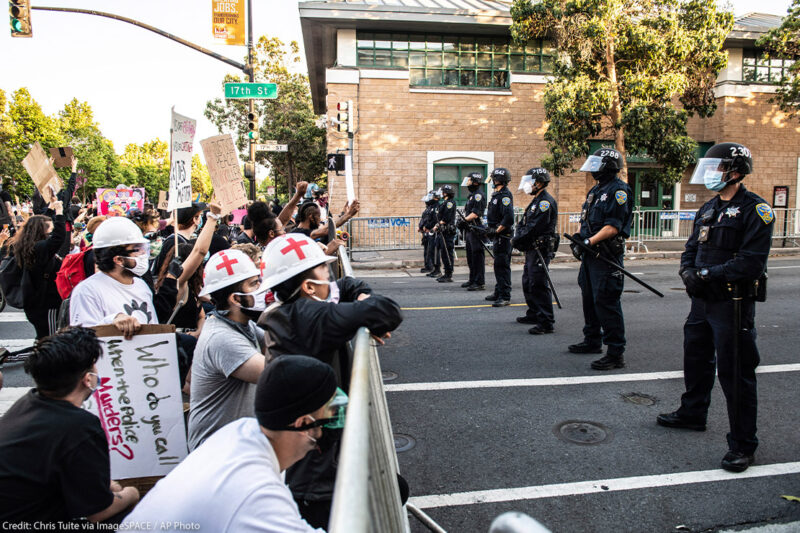
Police are supposed to “protect and serve” the community, but that’s a far cry from what modern-day policing often looks like in our country. The recent murders of Breonna Taylor, Tony McDade, George Floyd, and others highlight the need for drastic systemic change, yet again, as Americans across the country take to the streets in protest.
“The reason I’m out here is because I have two college degrees, but yet I'm still treated like I'm nothing,” one protester in Brooklyn told At Liberty this week. “I'm tired of hearing, there are a few rotten apples. There's not a few rotten apples. The tree is rotten. The tree is rotten from the roots up.”
ACLU Policing Policy Advisor Paige Fernandez joined us on the podcast this week to walk us through the history of our problematic policing systems, and explains both why it's so hard to hold police accountable, and how the ACLU plans to address this immense problem moving forward.
You can listen to the episode here:
Police are supposed to “protect and serve” the community, but that’s a far cry from what modern-day policing often looks like in our country. The recent murders of Breonna Taylor, Tony McDade, George Floyd, and others highlight the need for drasti...
Police are supposed to “protect and serve” the community, but that’s a far cry from what modern-day policing often looks like in our country. The recent murders of Breonna Taylor, Tony McDade, George Floyd, and others highlight the need for drasti...

Related Issues
Related Content
-
News & CommentaryAug 2026

Criminal Law Reform
+2 Issues
States Are Punishing Women Who Survive Violence With Incarceration. They Deserve Clemency.. Explore News & Commentary.States are Punishing Women Who Survive Violence with Incarceration. They Deserve Clemency.
One woman violently forced into assisting a murder seeks clemency in Michigan. Author and journalist Justine van der Leun calls for states to enact laws protecting criminalized survivors. -
News & CommentaryAug 2026
Immigrants' Rights
Criminal Law Reform
We’ve Filed More Than 50 Legal Claims Over Abuse By Federal Immigration Agents. Here's Why.. Explore News & Commentary.We’ve Filed More Than 50 Legal Claims Over Abuse by Federal Immigration Agents. Here's Why.
The claimants detail being unlawfully detained, denied medical care, or targeted simply for speaking out or recording what they saw. Their experiences reveal a dangerous pattern of abuse that threatens the rights and safety of us all. -
Minnesota Supreme CourtJul 2026

Criminal Law Reform
State V. Weisen. Explore Case.State v. Weisen
This case asks whether law enforcement may permissibly use trickery and deception to obtain consent for a search and/or induce a confession. This case has important implications for Minnesotans’ constitutional rights to be free from unreasonable searches and compelled self-incrimination. -
Press ReleaseJul 2026

Immigrants' Rights
Criminal Law Reform
Aclu Affiliates File More Than 50 Legal Claims Against The Federal Government On Behalf Of People Harmed By Federal Law Enforcement. Explore Press Release.ACLU Affiliates File More Than 50 Legal Claims Against the Federal Government on Behalf of People Harmed by Federal Law Enforcement
NEW YORK — The American Civil Liberties Union announced today that its affiliates have now filed 54 claims in 17 states and Washington, D.C. against the federal government on behalf of people who have suffered serious violence, abuse, and neglect at the hands of federal law enforcement. Since the beginning of President Trump’s second term, federal law enforcement agents have terrorized communities and people in their custody with a blatant disregard for the law. The consequences have been deadly. Conditions in ICE facilities are so inhumane that the rate of deaths in ICE custody has more than doubled since Trump’s term began, reaching its highest level in over a decade. In early July, reporting revealed that, after the White House pushed to increase arrest rates, ICE officials detained more than 10,000 people in five days. Only days later, ICE agents in unmarked vehicles shot and killed Lorenzo Salgado Araujo in Texas while he was on his way to work. The following week, a federal agent shot and killed Johan Sebastián Durán Guerrero in Maine. Across the country, ACLU affiliates are fighting back against the Trump administration’s illegal conduct by filing claims under the Federal Tort Claims Act (FTCA), one of the few legal tools available to seek financial compensation for wrongdoing by federal government employees. Through this coordinated effort, ACLU affiliates are representing dozens of people and families who are seeking justice for the harm they experienced at the hands of federal immigration agents. “As more than 50 of these cases show, federal agents’ violence, misconduct and utter disregard for the law is rampant,” said Yasmin Cader, deputy executive director of the ACLU. “President Trump and his law enforcement officers rely on a perceived sense of impunity, but no one is above the law. This administration is making everyone in America less safe and less free. That’s why the ACLU and its affiliates are fighting back at every turn.” Each of the 54 claims that have been filed tells an individual story of someone who was brutalized by federal immigration agents. Together, they reveal a widespread pattern of civil rights violations and abuse carried out by officials nationwide, affecting people who are immigrants, U.S. citizens, lawful permanent residents, families, workers, and people exercising their constitutional rights. These claims put names and faces to the harm that federal law enforcement agencies have been inflicting in communities across the country. The people represented include: A mother, who was five months into a high-risk pregnancy when she was held with her four children, including her 11-month-old child, in a CBP facility for approximately four weeks. The family was held in a cell with limited access to clean running water and without any windows to the outside. Rodney, from Georgia, who was arrested by ICE agents with guns drawn while his two young children watched, and was later denied needed medical care and accessibility accommodations while in ICE custody. Willy, a U.S. citizen in North Carolina, who was on his way back from a restaurant when federal immigration agents racially profiled him, put him in a headlock, and threw him to the ground. Norma Bowe, a grandmother, professor of public health at Kean University, and registered nurse, who was assaulted in front of Delaney Hall by ICE agents while there to operate her mobile health clinic. Darren, a U.S. citizen from Illinois, who was arrested at work after DHS agents broke through a gate to reach him, after which he required hospitalization for the two chemical irritants they used against him and was left without any of his confiscated property. “My story is not just about what happened to me. It’s about the kind of country we choose to be,” said Darren, a U.S. citizen being represented by the ACLU of Illinois. “No one should lose their dignity the moment they come face to face with those who hold power.” Earlier this month, the ACLU released a report analyzing immigration enforcement actions in the first year of President Trump’s second term. The report, Agents of Chaos and Cruelty, examines more than 1,200 immigration enforcement incidents across eight states and found that more than 400 of those incidents involved misconduct by immigration agents, including excessive force, racial profiling, and intimidation and abuse. “I was violently attacked by ICE agents while I was trying to provide medical care for people visiting their loved ones in Delaney Hall,” said Dr. Norma Bowe, a registered nurse and professor of public health at Kean University being represented by the ACLU of New Jersey. “ICE agents are acting like they have impunity and are inflicting harm however and whenever they want; without accountability, more people will get hurt and die. ICE must be held responsible.” The ACLU and its affiliates will continue to work to defend the rights of everyone, including people harmed by Trump’s immigration forces, and hold the administration accountable for its unlawful and inhumane actions. Read more about the clients ACLU affiliates are representing here: /campaigns-initiatives/the-people-v-agents-of-chaos-and-cruelty