What 'Let the Record Show' Reveals About a 200-Year-Old Petty Paperwork Problem That Gave Courts Its Power Today
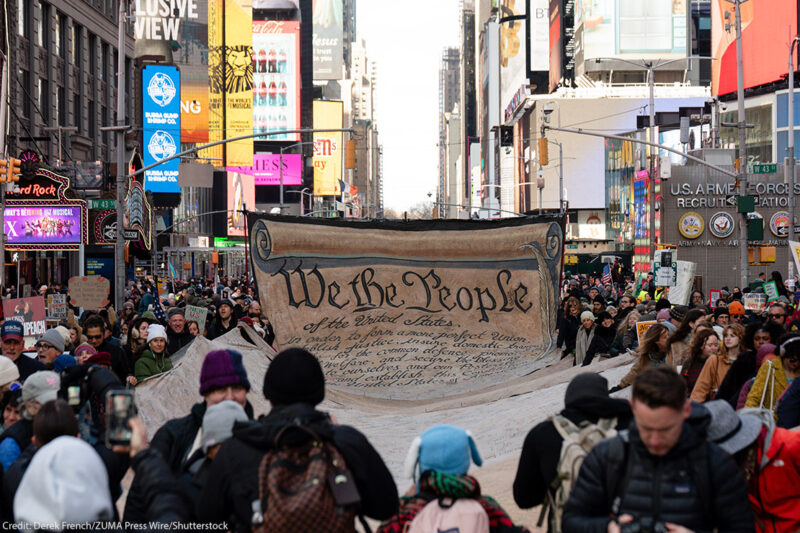
In the early 1800’s, two founding fathers ended up in a hiring dispute with a political appointee demanding his role as a judge in a lower court. But what started as a petty paperwork problem became a landmark case that established the Supreme Court’s greatest power: judicial review.
On the surface, Marbury v. Madison was a conflict about a presidential transition that upended the appointment of William Marbury, and by default, his political career. At its core, however, this case ensured the balance of political power and how courts should establish its authority to create checks and balances among the three branches of government.
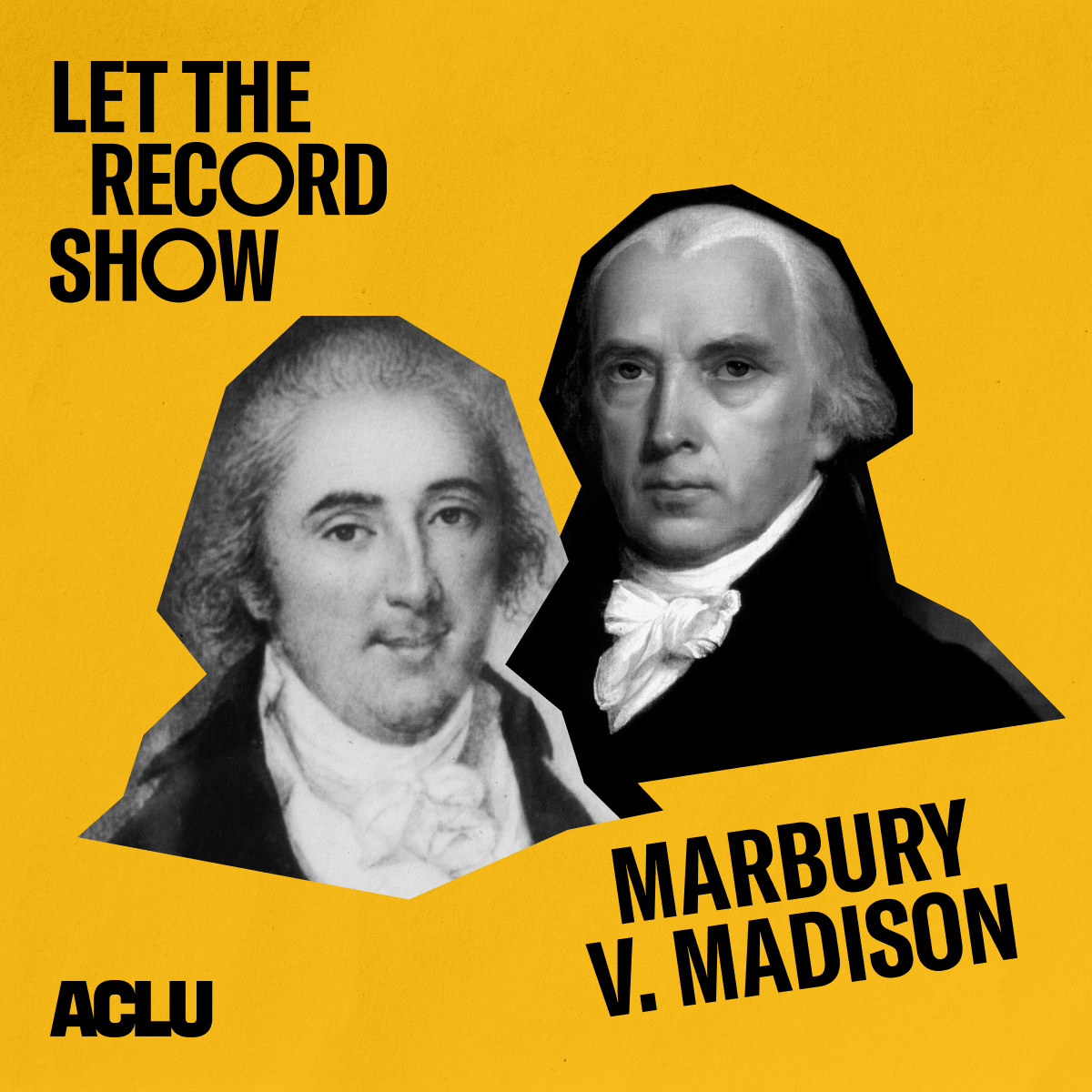
In the second episode of “Let the Record Show,” ACLU’s newest history podcast, hosts, Matt Beat and Shereen Marisol Meraji uncover the messy origins that led to the system of checks and balances as we know it today. Below, we continue the conversation to show how this crucial 200-year-old case gave us crucial rights as we know them today, such as, desegregation in schools, same-sex marriage, and birthright citizenship. You can catch up on our latest episode here.
Marbury v. Madison Establishes Courts’ Checks and Balances Power
On March 3, 1801, in the final hours of his presidency, President John Adams appointed Marbury as Justice of Peace in the District of Columbia. It was a way for the Federalist Party, a party that believed in a strong central government, to make a lasting impact as it lost government control to Thomas Jefferson, a Democratic Republican. His party believed in giving more power to the states.
The next day, Jefferson was sworn in as the president. He then appointed fellow founding father James Madison as secretary of state. Madison refused to honor Marbury’s appointment on the grounds that his appointment paperwork wasn’t delivered in time to beat the clock. And of course, Marbury protested.
Marbury took the case straight to the Supreme Court, which looked a bit different than it does today. At the time, the Supreme Court justices met in random rooms in the Capitol building. Not only did they handle mundane trials, its cases were usually settled within a few days, unlike today where cases can spend years making their way up to the Supreme Court. The framers of the Constitution also kept the Supreme Court’s role short and vague. It didn’t have as much power to, for example, determine if something was constitutional or not.
Chief Justice John Marshall presided over the Supreme Court at the time. Marbury demanded that the court provide an order that would force Madison to confirm the appointment. The ruling established that the Judiciary Act of 1789, a law that would have granted the court the ability to force the hand over, was unconstitutional. So, Marbury didn’t get the appointment in the end.
Cases | American Civil Liberties Union
Cases | American Civil Liberties Union
The court was eloquent is asserting its power of judicial review:
“Certainly all those who have framed written Constitutions contemplate them as forming the fundamental and paramount law of the nation,” , “and consequently the theory of every such government must be that an act of the Legislature repugnant to the Constitution is void.”
“If an act of the Legislature repugnant to the Constitution is void, does it, notwithstanding its invalidity, bind the Courts and oblige them to give it effect?” Marshall continued. “It is emphatically the province and duty of the Judicial Department to say what the law is...This is of the very essence of judicial duty.”
The ruling sets the precedent for judicial review at all levels of court, allowing courts to determine if policies like laws or executive orders are constitutional or not.
Judicial Review a Core Tenant to ACLU Work Throughout History
Judicial review, as we know it today, enables federal courts to examine government actions and determine whether they comply with the federal Constitution. It ensures there is a system of checks and balances among the three branches of government. The concept of judicial review underlies most of the ACLU’s work — the ACLU goes to court to demand that the actions of government comport with the Constitution.
"I've been in the legal department for decades now," said ACLU Deputy Legal Director Louise Melling on our podcast's latest episode. "Most everything we do is really about asking the court to exercise its power of judicial review."
Below, we've outlined some ways the courts have asserted its judicial review power to protect our civil liberties.
Brown v. Board of Education Bans Racial Segregation in Schools
More than 70 years ago, the Supreme Court ruled in Brown v. Board of Education that racial segregation in schools is unconstitutional and violates the Equal Protection Clause of the Fourteenth Amendment.
"In the field of public education, the doctrine of 'separate but equal' has no place," said Supreme Court Chief Justice Earl Warren. "Separate educational facilities are inherently unequal.
Brown v. Board of Education combined cases from five states, including in Kansas, where the plaintiff Oliver Brown's daughter Linda Brown was denied entry to a nearby white elementary school. In each case, the students were denied access under laws requiring or permitting segregation according to race. Exercising its power of judicial review, the Supreme Court struck down those laws.
The authority of the Supreme Court in this case opened the doors for desegregation, and it was one of the catalysts of the Civil Rights Movement of the 1960s.
Obergefell v. Hodges
More than a decade ago, the Supreme Court ruled that state laws banning marriage for same sex couples are unconstitutional. The decision addressed cases coming from four states, challenging laws that defined marriage as a union between one man and one woman. The ACLU was among the counsel in two of the cases before the Court, as well as in many of the cases brought around the country challenging state bans.

LGBTQ Rights
Obergefell, et al. v. Hodges - Freedom to Marry in Ohio
LGBTQ Rights
Obergefell, et al. v. Hodges - Freedom to Marry in Ohio
In holding unconstitutional state laws banning marriage for same sex couples, the Supreme Court said: “Under the Constitution, same-sex couples seek in marriage the same legal treatment as opposite-sex couples, and it would disparage their choices and diminish their personhood to deny them this right.”
"I was in a room with ACLU people when that decision came down," Melling said. "You can imagine the cheers and the tears in terms of knowing what this meant for people in the room, for our friends, for our loved ones, for people all across the country."
Lower Courts Have Checks and Balance Power, Too
Just last week, the ACLU filed a friend-of-the-court brief in support of CNN, MS NOW, and Politico in their lawsuit against the Trump administration over the revocation of their reporters' White House press credentials. The case was filed in the U.S. District Court for the District of Columbia. The brief supports the media companies' claim that the White House violated the First Amendment when it restricted their access to official events because Donald Trump has been unhappy with their coverage. Thanks to a temporary restraining order issued by a federal judge, the journalists have regained press access to the White House.
Related Issues
Related Content
-
Press ReleaseOct 2026

Civil Liberties
Aclu And Aclu Of North Carolina Launch Over $3.5 Million Campaign To Educate North Carolina Voters Ahead Of Midterm Elections. Explore Press Release.ACLU and ACLU of North Carolina Launch Over $3.5 Million Campaign to Educate North Carolina Voters Ahead of Midterm Elections
RALEIGH, N.C. – The American Civil Liberties Union of North Carolina and American Civil Liberties Union, Inc. today announced the launch of a joint campaign that will spend over $3.5 million to educate and engage North Carolina voters ahead of the Nov. 3 midterm elections. “For years, voters in North Carolina have watched as extreme politicians try over and over again to strip us of our rights – from our right to bodily autonomy to our right to fair representation,” said Liz Barber, ACLU of North Carolina director of policy and advocacy. “The ACLU is committed to ensuring that North Carolinians understand how state officials – like state supreme court justices and state legislators – can protect our rights, and where candidates for office this cycle stand on these important issues.” The organizations are spending $3.5 million on a series of statewide advertisements on social and digital media platforms and direct-to-voter mailers during the final weeks of the state Supreme Court race and key state legislative races. The advertisements will focus on educating voters about where candidates stand on key issues, including abortion rights and voting rights. This is the organizations’ largest electoral spend in North Carolina to date and will reach over 2.3 million voters. The spending is part of a multi-cycle strategy in North Carolina from the ACLU. In 2024, the ACLU of North Carolina and ACLU spent $750,000 on direct mail, digital ads, and grassroots outreach educating voters about issues at stake in the state Supreme Court and state legislative elections. The North Carolina Supreme Court is responsible for interpreting the state constitution and state laws. As the state’s highest court, it has the final say on many questions involving civil rights and civil liberties, and the North Carolina Constitution can provide broader protections than the U.S. Constitution. In 2022, for example, the court held that the North Carolina Constitution’s prohibition on cruel and unusual punishment can provide protections beyond those guaranteed by the Eighth Amendment. The ACLU of North Carolina, and ACLU are nonpartisan and do not support or oppose candidates for elected office. The organizations do, however, educate the voters about the issues at stake in elections and candidates’ positions and records on civil rights and civil liberties. -
CaliforniaOct 2026

Civil Liberties
+2 Issues
Salles, Et Al. V. National Institutes Of Health, Et Al.. Explore Case.Salles, et al. v. National Institutes of Health, et al.
Salles, et al. v. National Institutes of Health, et al. is a class action lawsuit challenging the censorship and termination of federally funded research by the National Institutes of Health (NIH). While ongoing litigation in APHA v. NIH successfully resulted in the reinstatement of hundreds of grants, NIH’s current policies continue to target viewpoints it opposes, threatening research because the government dislikes what it thinks the researchers believe or are likely to say, and continue to violate governing statutes and regulations. This is stymieing critical public health research, particularly related to climate change, the starkest health disparities including those faced by communities of color and LGBTQ+ populations, and other areas. -
News & CommentaryOct 2026
Civil Liberties
+4 Issues
This Supreme Court Term: Our Rights And Freedoms At Stake. Explore News & Commentary.This Supreme Court Term: Our Rights and Freedoms at Stake
The ACLU could have its busiest Supreme Court term ever, with potential cases on immigration, voting rights, and religious freedom in schools. -
Press ReleaseOct 2026
Civil Liberties
Aclu Announces The Arnie Miller Fund For The Next Generation. Explore Press Release.ACLU Announces the Arnie Miller Fund for the Next Generation
NEW YORK — The American Civil Liberties Union today announced that, through a generous $1 million anonymous gift, it has established the Arnie Miller Fund for the Next Generation to invest in emerging civil rights and civil liberties leaders. The Fund will support paid ACLU internships for law school and undergraduate students named "Arnie Miller Interns” and enrich programming for ACLU's highly competitive 18-month Pauli Murray Fellowship at the ACLU. The Fund aims to honor the late Arnold J. “Arnie” Miller’s fierce commitment to mentorship, to cultivating a diverse pipeline of talented future leaders, including women, people of color, and underrepresented communities, and to uplifting the next generation of aspiring young leaders in public interest roles. “Arnie Miller spent his life lifting people up, because he understood that people and community are our best assets. We’re proud to be able to turn this generous gift into a long-term program to train and develop young people who are passionate about civil rights and civil liberties,” said Anthony D. Romero, ACLU executive director. “We continue to honor Arnie’s memory by investing in the people who will carry this work forward.” Arnie Miller grew up in the Bronx and served as an Army Lieutenant in post-war Korea before entering politics amid the antiwar movement of the 1960s and 70s. He served in the Carter administration as Director of the Presidential Personnel Office, helping bring more women and people of color into senior federal roles than any prior administration, and later founded Isaacson, Miller, an executive search firm serving mission-driven nonprofits and foundations. “Arnie believed deeply that young people with courage and determination could make a difference in our world. Throughout his life, he found enormous joy in helping others find their path and opening doors that might otherwise have remained closed. I know he would be deeply moved to see this fund carrying that spirit forward, giving the next generation the opportunity to serve, to lead, and to make our communities better. There is no more meaningful way to honor his memory,” said Deb DeLee, Arnie's longtime partner. The Arnie Miller Fund for the Next Generation will help the ACLU foster the exceptional talent of early-career professionals and welcomes additional gifts from those inspired by Arnie's legacy, ensuring the ACLU can continue to create opportunities for early-career professionals to enhance their skills, grow as leaders, and build careers dedicated to justice, equality, and freedom. Learn more about the Arnie Miller Fund for the Next Generation at /arnie-miller-fund and the Pauli Murray Fellowship at /pauli-murray-fellowship.