Supreme Court Term 2025-2026
We’re breaking down the cases we've asked the court to consider this term.

Latest Case Updates
Ongoing
Updated August 17, 2026
Ongoing
Updated August 17, 2026
Closed
Updated August 6, 2026
Ongoing
Updated July 29, 2026
Featured
Massachusetts
Aug 2026
Voting Rights
League of Women Voters of Massachusetts v. Trump
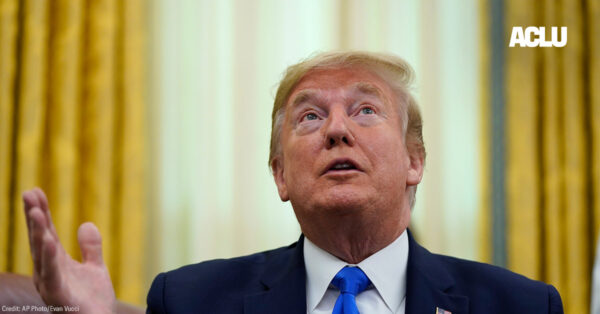
On March 31, 2026, President Trump issued a sweeping Executive Order titled "Ensuring Citizen Verification and Integrity in Federal Elections," seeking once again to seize control of election administration from Congress and the states. The Order directs federal agencies to compile lists of U.S. citizens and transmit them to states before every election, directs the U.S. Postal Service -- an independent agency established by Congress -- to create a list of "approved" mail voters, and instructs USPS to refuse to deliver ballots from voters not on that federally created list. If implemented, the Order would threaten the ability of millions of eligible citizens to cast their ballots, particularly military members, overseas citizens, the elderly, recently naturalized citizens, and voters with disabilities who rely on mail voting.
Florida
Aug 2026

National Security
+2 Issues
CAIR-Foundation, Inc and CAIR Florida, Inc. v. DeSantis et al.
The ACLU, the ACLU of Florida, the Southern Poverty Law Center, and their partners represent CAIR and CAIR-Florida in two federal lawsuits challenging Governor DeSantis’s unconstitutional and baseless designation of the nonprofits as “terrorist.” The lawsuits allege violations of CAIR and CAIR-Florida’s rights under the First Amendment and the due process clause of the Fourteenth Amendment.
Court Case
Jul 2026
National Security
Human Rights
FOIA Case Seeking the Trump Administration’s Legal Justification for Deadly Boat Strikes
The Department of Justice’s Office of Legal Counsel (“OLC”) authored a legal opinion that reportedly claims to justify the Trump administration’s illegal lethal strikes on civilians in boats in the Caribbean Sea and eastern Pacific Ocean. Media reports indicate that, in addition to claiming that the strikes are lawful acts in an alleged “armed conflict” with unspecified drug cartels, the OLC opinion also purports to immunize personnel who authorized or took part in the strikes from future criminal prosecution. Because the public deserves to know how our government is justifying these illegal strikes, and why they think the people who carried them out should not be held accountable, the ACLU is seeking immediate release of the OLC legal opinion and related documents pursuant to the Freedom of Information Act.
Arizona
Jul 2026

Prisoners' Rights
Jensen v. Thornell
UPDATE: On July 17, 2026, U.S. District Judge Roslyn O. Silver issued an order formally appointing a receiver to assume control and management of health care provided to more than 25,000 people incarcerated in Arizona Department of Corrections, Rehabilitation, and Reentry (ADCRR) prisons, in a long-running lawsuit against the state prison system brought by the Prison Law Office, the American Civil Liberties Union (ACLU), ACLU of Arizona, and Disability Rights Arizona. More details here.
New Hampshire
Jul 2026
Voting Rights
Coalition for Open Democracy v. Scanlan
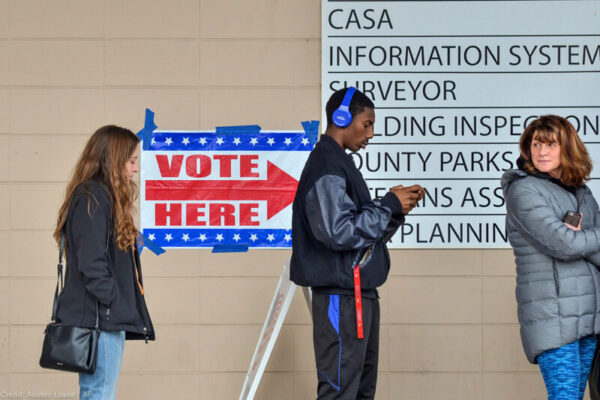
This lawsuit challenges HB 1569, a new law that will make New Hampshire the only state to require every person to produce documentary proof of citizenship when they register to vote for both state and federal elections. It also challenges HB 1569’s elimination a preexisting protection for voters—namely, an affidavit option that allowed voters who faced surprise challenges to their eligibility at the polls to swear to their qualifications and cast a ballot. Accordingly, HB 1569 violates the First and Fourteenth Amendments of the U.S. Constitution by placing substantial burdens on New Hampshirites at all stages of the voting process, and will arbitrarily disenfranchise hundreds, if not thousands of qualified voters.
U.S. Supreme Court
May 2026
Voting Rights
Racial Justice
Allen v. Milligan
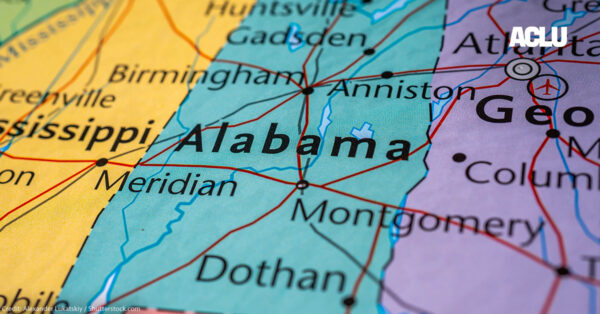
Whether Alabama’s congressional districts violate Section 2 of the Voting Rights Act because they discriminate against Black voters. We succeeded in winning a new map for 2024 elections which, for the first time, has two congressional district that provide Black voters a fair opportunity to elect candidates of their choosing despite multiple attempts by Alabama to stop us at the Supreme Court. Despite this win, Alabama is still defending its discriminatory map, and a trial was held in February 2025 to determine the map for the rest of the decade.
In May 2025, a federal court ruled that Alabama's 2023 congressional map both violates Section 2 of the Voting Rights Act and was enacted by the Alabama Legislature with racially discriminatory intent.
U.S. Supreme Court
Apr 2026

Voting Rights
Louisiana v. Callais (Callais v. Landry)
Whether the congressional map Louisiana adopted to cure a Voting Rights Act violation in Robinson v. Ardoin is itself unlawful as a gerrymander.
Tennessee Supreme Court
Apr 2026

Capital Punishment
Tony Von Carruthers v. State of Tennessee
Tennessee plans to execute Tony Carruthers on May 21 even though they refuse to run a simple fingerprint comparison and DNA testing that could prove what Tony has been arguing for 30 years - that he is innocent of this crime and that Tennessee convicted and sentenced the wrong man to death.
U.S. Supreme Court
Feb 2026

Immigrants' Rights
Barbara v. Donald J. Trump
President Trump is attempting to undermine the promise of birthright citizenship to children born on U.S. soil. But the ACLU and partners are fighting to protect the rights of citizens that are plainly stated in the Constitution, federal statute, and reaffirmed by the Supreme Court for more than a century. We’re arguing against the Trump administration in the Supreme Court and are confident we will win.
All Cases
1,738 Court Cases

Court Case
Aug 2024
Criminal Law Reform
Capital Punishment
Abdullahi Khalif Noor v. Melissa Andrewjeski
Abdullahi Khalif Noor is a Somali refugee, who was a cab driver living in Seattle when convicted of rape and assault, and sentenced to life imprisonment. He has always maintained his innocence. He challenged his convictions in Washington state courts, arguing that prosecutors had suppressed evidence of his innocence in violation of due process and Brady v. Maryland.
Unsuccessful in the Washington state courts, he filed a petition for a writ of habeas corpus in federal district court. He was again unsuccessful, and sought to appeal to the U.S. Court of Appeals for the Ninth Circuit. Ordinarily, when a party loses in federal district court they can immediately appeal the decision. But Mr. Noor was barred from doing so because he had not obtained a document Congress has required habeas petitioners receive from federal courts before they can appeal since 1908 — then called a certificate of probable cause, but now called a certificate of appealability (COA).
Explore case
Court Case
Aug 2024
Criminal Law Reform
Capital Punishment
Abdullahi Khalif Noor v. Melissa Andrewjeski
Abdullahi Khalif Noor is a Somali refugee, who was a cab driver living in Seattle when convicted of rape and assault, and sentenced to life imprisonment. He has always maintained his innocence. He challenged his convictions in Washington state courts, arguing that prosecutors had suppressed evidence of his innocence in violation of due process and Brady v. Maryland.
Unsuccessful in the Washington state courts, he filed a petition for a writ of habeas corpus in federal district court. He was again unsuccessful, and sought to appeal to the U.S. Court of Appeals for the Ninth Circuit. Ordinarily, when a party loses in federal district court they can immediately appeal the decision. But Mr. Noor was barred from doing so because he had not obtained a document Congress has required habeas petitioners receive from federal courts before they can appeal since 1908 — then called a certificate of probable cause, but now called a certificate of appealability (COA).
Ohio
Aug 2024
Reproductive Freedom
Preterm-Cleveland, et al, v. Dave Yost, et al.
The American Civil Liberties Union, the ACLU of Ohio, Planned Parenthood Federation of America, and the law firm Covington & Burling LLP filed a lawsuit challenging several Ohio laws that together force abortion patients to wait a minimum of 24 hours after receiving unnecessary state-mandated information in person before they can access their desired abortion care. These laws violate Ohio’s constitutional right to reproductive freedom passed on November 7, 2023. Ohio is one of four states that have amended their constitutions to enshrine a fundamental right to abortion since the U.S. Supreme Court’s ruling in Dobbs v. Jackson Women’s Health Organization.
Explore case
Ohio
Aug 2024
Reproductive Freedom
Preterm-Cleveland, et al, v. Dave Yost, et al.
The American Civil Liberties Union, the ACLU of Ohio, Planned Parenthood Federation of America, and the law firm Covington & Burling LLP filed a lawsuit challenging several Ohio laws that together force abortion patients to wait a minimum of 24 hours after receiving unnecessary state-mandated information in person before they can access their desired abortion care. These laws violate Ohio’s constitutional right to reproductive freedom passed on November 7, 2023. Ohio is one of four states that have amended their constitutions to enshrine a fundamental right to abortion since the U.S. Supreme Court’s ruling in Dobbs v. Jackson Women’s Health Organization.

Delaware
Aug 2024
Voting Rights
Prisoner’s Legal Advocacy Network v. Carney
Right now, an entire class of eligible voters in Delaware — those incarcerated in Delaware facilities while awaiting trial (“pretrial detainees”) or who have been convicted of misdemeanors, which are not disqualifying under state law (together with pretrial detainees, “eligible incarcerated voters”)—have no constitutional means of voting. Delaware does not permit in-person voting in its correctional facilities. And a recent Delaware Supreme Court decision has now foreclosed these voters from voting absentee. This leaves these voters completely disenfranchised ahead of the 2024 elections, in violation of the Fourteenth Amendment to the U.S. Constitution.
Explore case
Delaware
Aug 2024
Voting Rights
Prisoner’s Legal Advocacy Network v. Carney
Right now, an entire class of eligible voters in Delaware — those incarcerated in Delaware facilities while awaiting trial (“pretrial detainees”) or who have been convicted of misdemeanors, which are not disqualifying under state law (together with pretrial detainees, “eligible incarcerated voters”)—have no constitutional means of voting. Delaware does not permit in-person voting in its correctional facilities. And a recent Delaware Supreme Court decision has now foreclosed these voters from voting absentee. This leaves these voters completely disenfranchised ahead of the 2024 elections, in violation of the Fourteenth Amendment to the U.S. Constitution.
Arizona
Aug 2024
Voting Rights
Mi Familia Vota v. Fontes (Amicus)
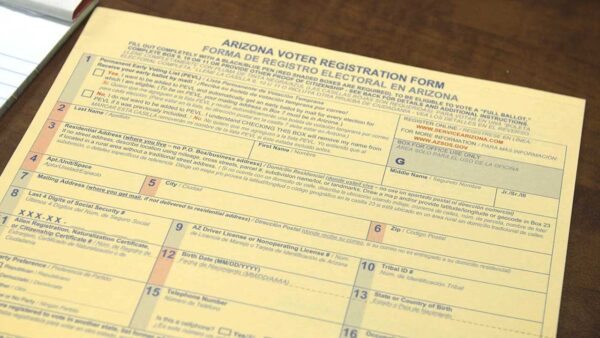
Does Congress have authority (as it has long done) to regulate all federal elections, including presidential elections—such as through key federal voting rights laws like the NVRA, UOCAVA, and the MOVE Act?
Explore case
Arizona
Aug 2024
Voting Rights
Mi Familia Vota v. Fontes (Amicus)
Does Congress have authority (as it has long done) to regulate all federal elections, including presidential elections—such as through key federal voting rights laws like the NVRA, UOCAVA, and the MOVE Act?